A growing share of searches now get answered before a user ever clicks a link. Google’s AI Overviews summarize an answer directly at the top of the results page. ChatGPT, Perplexity, and similar tools answer questions directly, often citing a small number of sources along the way. For a business trying to get found, this changes what “ranking well” actually means, and a lot of standard SEO advice does not fully cover it.
This is generative engine optimization, usually shortened to GEO: optimizing not just to rank in a list of links, but to be the source an AI system actually pulls from and cites when answering a question.
Why This Matters for a Local Winnipeg Business
If someone asks ChatGPT “what’s a good web design company in Winnipeg” or Google’s AI Overview summarizes an answer to “how much does local SEO cost,” the businesses that get mentioned are pulled from somewhere. Understanding what makes content citable in that context is quickly becoming as important as understanding what makes a page rank in traditional search results, and the two overlap significantly but are not identical.
What AI Systems Actually Look For
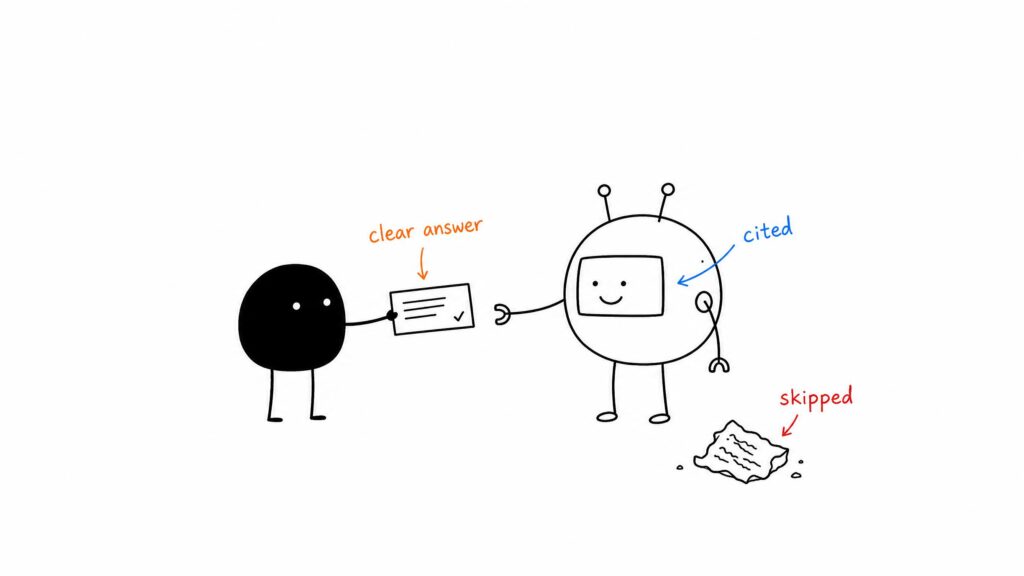
Clear, complete, standalone answers. AI tools tend to pull content that directly and completely answers a specific question without requiring the reader to click through for the actual information. A page that says “find out more about our pricing by contacting us” gives an AI system nothing usable to cite. A page that states an actual answer, even a range or a general framework, gives it something concrete to summarize and attribute.
Structured, scannable content. Clear headings, direct answers early in a section, and genuinely well-organized FAQ content all make it easier for an AI system to parse what a page is actually saying and extract a citable answer from it.
Consistent entity information. AI systems, like search engines before them, build a picture of a business as an entity, not just a webpage. Consistent naming, location information, and service descriptions across your website, Google Business Profile, and other citations help reinforce that picture rather than creating ambiguity about what your business actually is or does.
Genuine expertise signals. Named authors, real credentials, and specific, original commentary (not generic advice that could apply to any business in any city) all strengthen the case that a page is a credible source worth citing, rather than one of many similar-sounding pages saying the same generic thing.
What This Looks Like in Practice
A page built around a single vague question tends to underperform here. A page built to directly and completely answer several specific, related questions, each with a clear standalone answer, tends to perform much better, both for AI citation and for capturing the traditional People Also Ask and featured snippet placements in regular search results. This is part of why we build a real FAQ section into content like this post, not as an SEO formality, but because that structure genuinely matches how these questions get asked and answered in both traditional and AI-powered search.
Local specificity matters here more than it might seem. A generic answer to “how much does local SEO cost” is less useful to an AI system trying to answer a Winnipeg-specific query than an answer that explicitly addresses the Winnipeg market, the way our local SEO cost guide does. Specificity is not just good practice, it is a genuine differentiator between content an AI system finds generic and interchangeable versus content it finds distinctly useful to cite for a particular query.
What Has Not Changed
Despite the new terminology, the underlying fundamentals of good SEO still matter and still form the foundation GEO is built on top of. A technically sound, fast, mobile-friendly website. Genuinely helpful, well-organized content. A track record of expertise and trustworthiness. None of that goes away because AI Overviews exist, it becomes the baseline that GEO-specific tactics get added to, not something GEO replaces. Our search engine optimization page covers that full foundation, with GEO built in as part of the content and structure recommendations, not treated as a separate, disconnected service.
A Practical Starting Point
If you are wondering where to start, look at your own site’s FAQ content, or lack of it. Are the questions your customers actually ask answered directly and completely somewhere on your site, in a way a stranger (or an AI system reading on their behalf) could understand without extra context? If not, that gap is usually the fastest, most concrete place to start closing the distance between where your content is today and where it needs to be to get cited by AI search tools.
Frequently Asked Questions
What is GEO (generative engine optimization)?
GEO is the practice of optimizing content to be cited and summarized by AI-powered search tools like Google’s AI Overviews, ChatGPT, and Perplexity, rather than only optimizing to rank in a traditional list of search results.
Is GEO replacing traditional SEO?
No. GEO builds on the same foundation as traditional SEO (technical health, content quality, expertise signals) and adds specific structural and content practices on top of it. A site with weak SEO fundamentals will struggle with GEO too.
How do I know if my business is being mentioned in AI search results?
Try asking ChatGPT, Perplexity, or searching Google for questions a potential customer might ask about your industry and location, and see whether your business or website comes up. This kind of manual spot-checking is currently the most direct way to gauge visibility, since dedicated tracking tools for this are still maturing.
Does having FAQ content actually help with AI search visibility?
Yes, when the answers are complete and standalone rather than fragments that require clicking through. Well-structured FAQ content is one of the more directly useful formats for both traditional featured snippets and AI-generated answers.
Should a small Winnipeg business prioritize GEO over regular SEO?
No, prioritize the SEO foundation first if it is not already solid, since GEO builds on top of it rather than replacing it. Once the fundamentals are in place, adding GEO-specific structure (complete standalone answers, consistent entity information) is a natural next step rather than a separate initiative.
Curious how your content shows up in AI search tools right now? Get in touch with our team and we will take a look together.