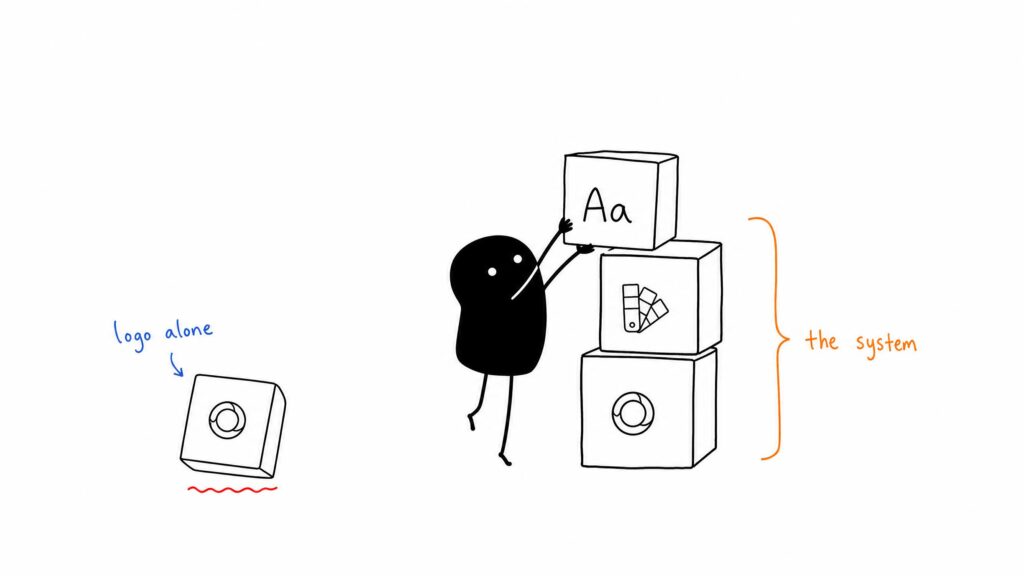
Most small business owners hear “brand identity” and think “logo.” A logo is part of it, but it is a small part, and treating it as the whole project is exactly why some businesses end up with a nice-looking mark and nothing else that actually feels consistent across their website, social media, packaging, or signage.
This guide covers what a real brand identity actually includes, what a small business genuinely needs to start, and what can reasonably wait.
What Brand Identity Actually Means
A complete brand identity typically includes a primary logo and its variations (a simplified icon version, a horizontal lockup, a stacked version for square spaces), a defined colour palette with specific codes for consistency across print and digital, typography choices for headlines and body text, and a set of usage guidelines that keep all of it consistent no matter who is applying it, whether that is your web designer, a print shop, or you making a social media post yourself.
Without that last piece, the guidelines, brand identity tends to drift. The logo might stay the same, but the colours shift slightly between your website and your business cards, or three different fonts end up in use across different materials, and the overall impression starts to feel inconsistent even if no single piece looks bad on its own.
What a New Small Business Actually Needs to Start
Not everything above needs to happen at once. For a business just getting started, the essentials are a primary logo with at least one simplified variation, two to four brand colours with exact codes, one or two typefaces, and a one-page style guide covering how to use all of it correctly. That is enough to launch a website, order business cards, and post to social media consistently.
Things that can reasonably wait until the business has more traction include a full packaging system, an extensive icon library, detailed print collateral templates, and a comprehensive brand guidelines document beyond the basics. Building all of it upfront for a business that has not yet found its footing often means paying for structure the business does not need yet, and revisiting it anyway once real growth clarifies what the brand actually needs to support.
Signs Your Business Needs a Brand Identity Refresh, Not Just a New Logo
If your current visual identity was built years ago and no longer reflects where the business actually is, if you are inconsistent across platforms because there was never a real system to begin with, or if a competitor with a much stronger visual presence is starting to win business that should be yours, those are signals for a genuine identity project, not just a logo swap. A logo update without addressing the underlying system usually just moves the inconsistency problem rather than solving it.
Luxury and premium-positioned brands feel this gap especially sharply, since the visual identity is doing more of the persuasion work than in a lower-consideration category. OD AXIOM INEFFABLE (OAI) is a good example of this: a luxury brand that needed a full digital identity built to actually match the level of the product, not a logo refresh bolted onto an otherwise inconsistent system.
How to Brief a Graphic Designer Well
The single biggest driver of a smooth brand identity project is a clear, honest brief upfront. That means being specific about your actual customer (not “everyone,” a real description of who buys from you), gathering 3 to 5 examples of brands you genuinely admire and being able to say why, being honest about budget rather than waiting for a designer to guess, and having a realistic sense of timeline, since a rushed identity project usually shows in the final result.
Avoid briefs built entirely around “make it pop” or “modern but classic,” phrases that feel like direction but give a designer nothing concrete to work from. Specific reference points and honest constraints produce far better outcomes than vague enthusiasm.
What to Expect From the Process
A real brand identity project typically moves through discovery (understanding the business, audience, and competitors), concept development (usually 2 to 3 distinct directions to choose from, not endless open-ended exploration), refinement of the chosen direction, and finally a full delivery package with usage guidelines. Rushing past discovery is one of the most common reasons identity projects miss the mark, because the visual work ends up disconnected from what the business actually needs it to communicate. Our Graphic Design page walks through how we structure this process for Winnipeg businesses of different sizes and budgets.
Frequently Asked Questions
What is the difference between a logo and a brand identity?
A logo is one visual mark. A brand identity is the full system around it, including colour, typography, imagery style, and usage guidelines that keep everything consistent across every place your business shows up.
How much should a small business budget for brand identity?
It varies widely based on scope, but a focused starter package (logo, colour palette, typography, basic guidelines) is generally far more affordable than a comprehensive full-system project, and is the right starting point for most new small businesses.
Do I need a brand identity before building a website?
Ideally yes, or at minimum in parallel. Building a website without a defined identity often means redesigning it again once the identity is finalized, since colours, fonts, and logo treatment all directly affect the site’s design.
How long does a brand identity project take?
A focused small business identity project typically takes 3 to 6 weeks. More comprehensive projects with extensive guidelines and collateral can take longer, especially if multiple rounds of concept exploration are involved.
Can I update my brand identity gradually instead of all at once?
Yes, and for many small businesses this is the practical choice. Starting with the essentials (logo, colours, typography, a basic guideline) and expanding the system as the business grows is a reasonable, budget-conscious approach.
Thinking about a brand identity project? Get in touch with our team and we will help you figure out what your business actually needs right now.